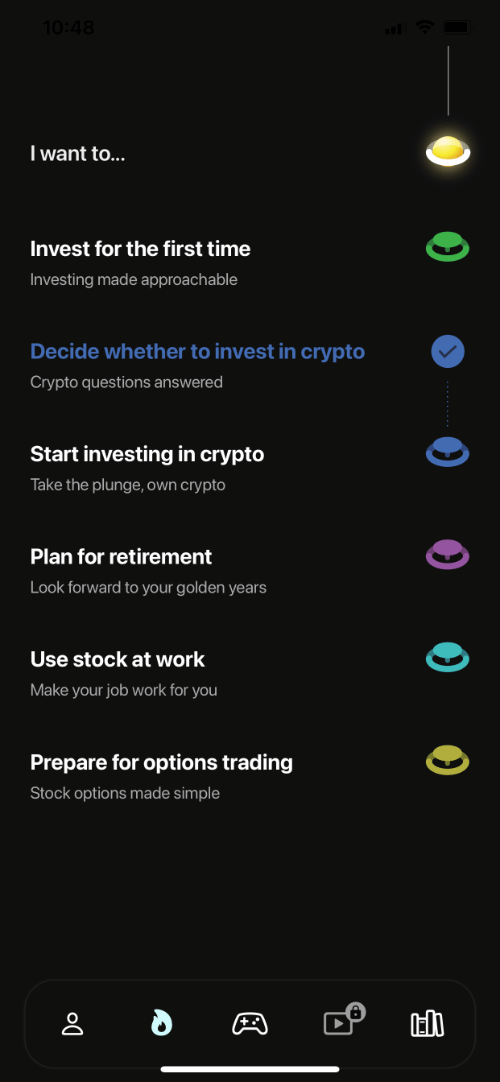
Gain the confidence to make investing a bigger part of your life.
170+ lessons for all audiences
Start for free
Become a better investor

Start learning the fundamentals of this innovative technology.
Since crypto is natively digital and natively online, we can have our laptops/computers open and follow along while exploring the world of crypto.
Share your videos with friends, family, and the world
To get a sense of the investable markets for cryptocurrencies, let's consider coingecko to be the homepage.

View top cryptocurrency prices live, crypto charts, market cap, and trading volume. Discover today’s new and trending coins, top crypto gainers and losers in the market.
When talking about bitcoin, there are two different things going on:
So in this case, we have the bitcoin blockchain and the asset of the blockchain, BTC (bitcoin), which is the currency that gets traded. Utility tokens are the assets of other blockchains.
Whenever we see blockchain, we can think of a distributed ledger or public ledger; a record-keeping system that keeps the identities of the parties involved in a transaction secure and pseudonymous in a way that is shared without a central administrator.
Bitcoin blockchain was the original technology but has since been improved by other organizations, such as Ethereum, to create more efficient blockchains.
Here is a great visual resource for understanding how blockchains work, looking at both Bitcoin and Ethereum using the analogy of a bus station:
As shown on the site, Ethereum is much faster at completing transactions, supporting a greater number of applications for complex global commerce.
Blockchains are often called smart contract platforms because complex financial contracts (or simple ones, like transferring funds on someone's birthday each year) can be encoded into one of the blocks. This gives us greater self sovereignty since we no longer need to rely on a centralized entity, like a bank, to perform the same transaction.
To get a better sense of how people are building on the blockchain and cryptocurrency technology, we can look at it from the perspective of the OSI model.
Without being a developer, we can understand that there are multiple layers: starting with the physical layer (our computer or the phone in our hand) all the way to the last application layer which are apps, much like this one, that we interact with most of the time.
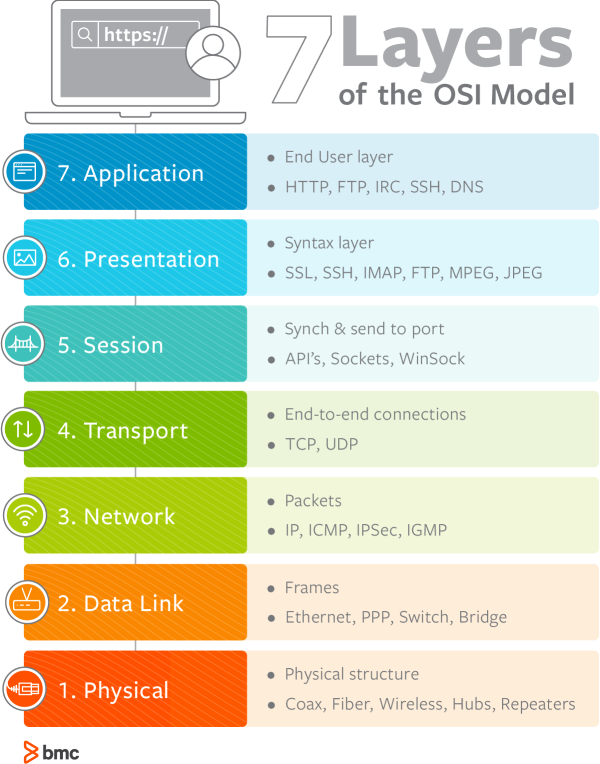
To apply this to the crypto space, the organizations working in first layer include the blockchains and smart contract platforms with multiple layers of middleware solutions, tools and services, until the last layer which would be consumer facing applications that most of us interact with.
Remember, blockchains are synonymous with distributed or public ledgers and so they lend themselves to decentralizing finance. Decentralized finance is when our data is owned collectively among us all on decentralized nodes or computers scattered around the world rather than having a bank hold all of the money on centralized servers.
There are varying degrees of decentralization and it will likely take decades to transition into a fully decentralized financial system.
Smart contracts are immutable contracts (like our example of the recurring birthday money) that live on the blockchain and that cost the utility token native to that blockchain in order to change. Changing a smart contract on the Ethereum blockchain will cost ETH tokens.
One of the easiest ways to transact on a blockchain is by using a browser extension which serves as our wallet. These wallets are convenient for adding many different types of tokens that can be used for a myriad of transactions. Keeping a seed phrase allows us to access this wallet anywhere in the world through a browser.